
Custom Monument Signs in Houston: The Ultimate Guide to Architectural Branding
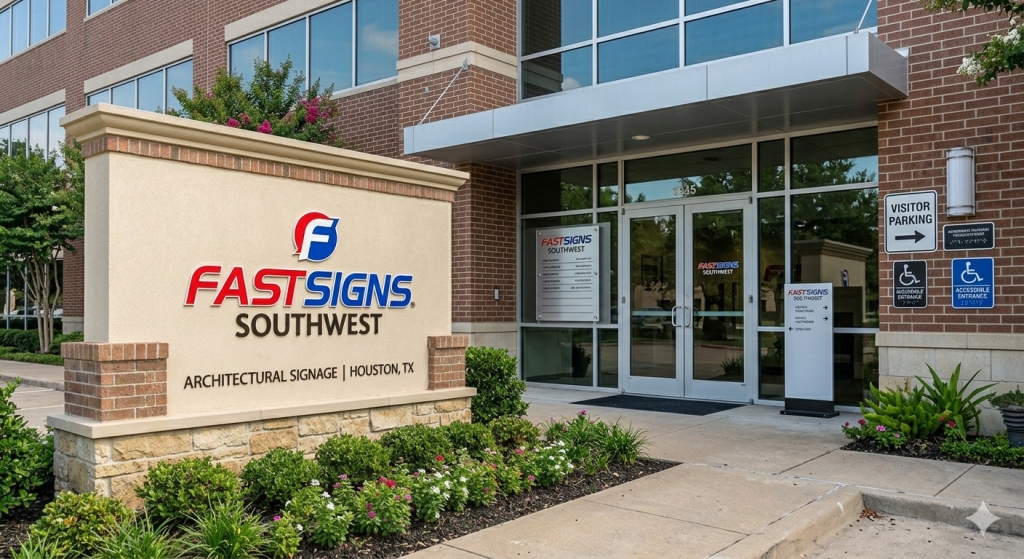
Why Custom Monument Signs Are the Foundation of Physical Branding
Before a customer reads your name, they judge your credibility. In the three seconds it takes a driver to pass your entrance, your monument sign communicates one of two things: this business is established and trustworthy, or this business is an afterthought.
At Fastsigns Southwest, we’ve installed hundreds of custom monument signs along the Southwest Freeway corridor and throughout Greater Houston. The businesses that invest in architectural signage consistently report one measurable outcome: people actually find them. Not because the sign is flashy — but because a permanent, well-lit monument sign anchors a location in a customer’s mental map of the city.
This guide covers everything you need to know in 2026: materials that survive Houston’s brutal climate, how to navigate the city’s permit process, digital integration options, and what a realistic budget looks like for your school, church, or business.
The Psychology Behind the “Sense of Arrival”
Urban planners call it placemaking — the idea that physical environments shape how people feel about a destination before they walk through the door. Monument signs are a direct application of this principle.
For schools and universities: A carved stone or HDU Custom Monument Signs at the entrance signals institutional permanence. It tells prospective families, alumni, and staff that this campus has roots. Districts like HISD and Katy ISD use monument signage as part of a broader campus identity program precisely because it elevates perceived quality.
For churches and faith communities: A dignified Custom Monument Signs is a 24/7 invitation. It tells the neighborhood — even people driving past at midnight — that this congregation is present, welcoming, and here to stay. Many of our Houston church clients add interchangeable letter panels or an integrated EMC display to communicate service times and community events.
For medical offices and professional buildings: Patients and clients use monument signs as wayfinding anchors. In a commercial park with multiple tenants, a monument sign at the driveway entrance eliminates the anxiety of “am I in the right place?” — which matters more than most business owners realize.
Consumer trust in 2026 is increasingly tied to physical presence. In an era of faceless online transactions, a substantial monument sign signals that your organization has a real address, real accountability, and real staying power.
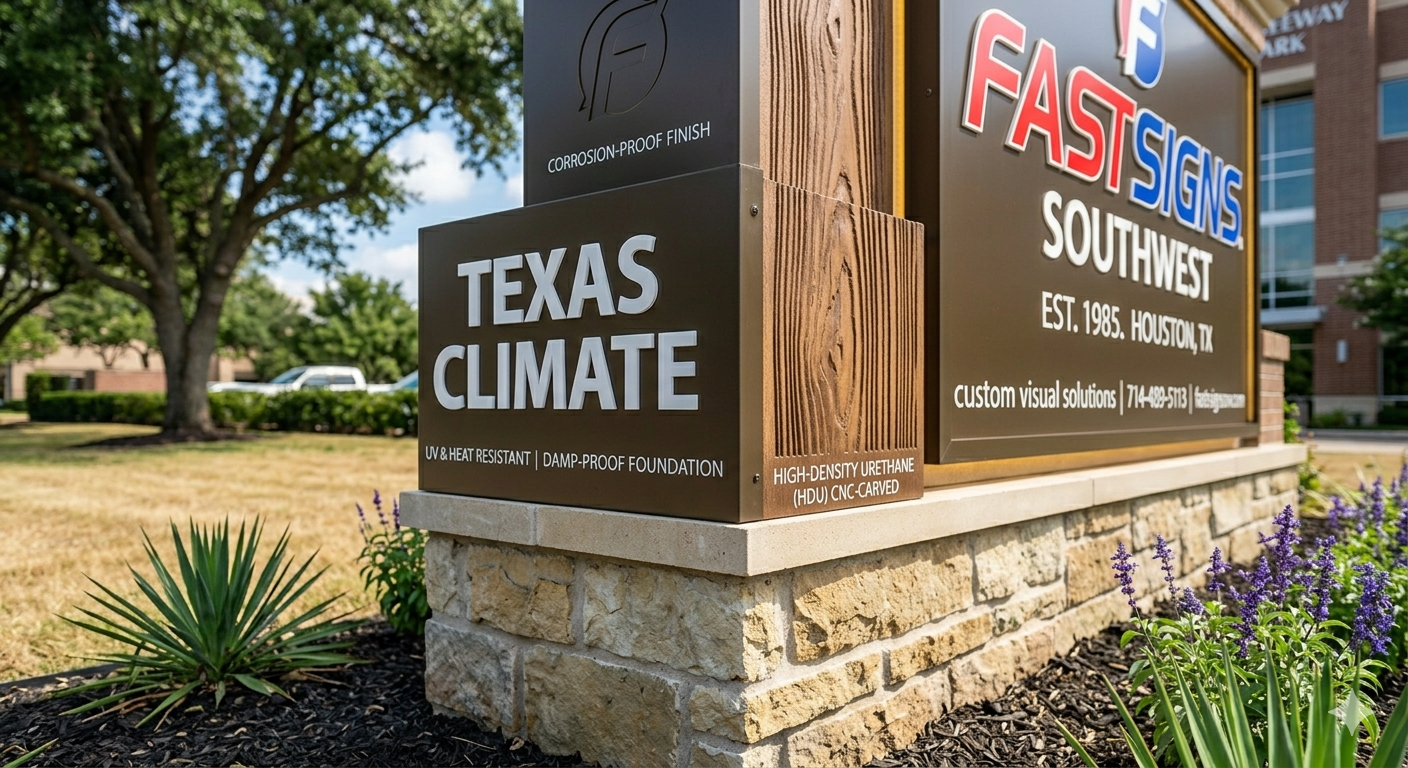
Material Science: Custom Monument Signs Built for the Texas Climate
Houston ranks among the most demanding environments for exterior signage in North America. The combination of Gulf Coast humidity (averaging 75% relative humidity year-round), summer temperatures that regularly exceed 100°F, and tropical storm exposure means that materials appropriate in Dallas or Austin may fail within five years in Houston. Here is what we specify and why.
High-Density Urethane (HDU) Foam
High-Density Urethane foam has become the dominant material for architectural monument signs in the Gulf Coast region, and for good reason. HDU is:
- 100% waterproof — Unlike wood, MDO, or standard foam, HDU has a closed-cell structure that prevents water absorption. It will not rot, warp, swell, or develop mold regardless of how many Hurricane seasons it weathers.
- CNC-precision carved — Our shop uses CNC routers to cut HDU to tolerances of 1/32 of an inch, producing crisp letterforms, deep relief textures, and ornamental details that look hand-carved but are perfectly repeatable across multiple panels.
- Paintable and primeable — HDU accepts automotive-grade primers and UV-stabilized exterior paints. A properly finished HDU sign will hold its color for 10–15 years with minimal maintenance.
- Lightweight — An HDU panel that mimics the appearance of 4-inch-deep carved limestone weighs a fraction of actual stone, reducing structural foundation requirements and installation cost.
Best for: Schools, churches, neighborhood entries, corporate campuses, professional office parks.
EPS Foam with Armor-Coat Finish
Expanded Polystyrene (EPS) foam with a hard polymer or fiberglass-reinforced “armor coat” finish is the material of choice when you need to replicate large masonry structures — full columns, archways, or signs that genuinely look like they were built from Austin stone or Houston brick — at a fraction of the masonry cost.
Our EPS monument structures are routinely mistaken for real masonry, even on close inspection. The armor coat finish can be textured and colored to match:
- Austin limestone (the warm, sandy look popular in Hill Country-style architecture)
- Red clay brick (common in traditional Houston commercial corridors)
- Stacked slate or fieldstone (popular for church and school applications)
- Smooth stucco (for contemporary office and medical park aesthetics)
The material cost advantage is significant: a monument sign structure built in EPS foam with armor coat typically costs 35–45% less to install than equivalent real masonry, with no sacrifice in visual impact and substantially better long-term performance (no mortar cracking, no water infiltration between joints).
Best for: Large gateway structures, multi-tenant property entrances, HOA neighborhood signs, campus welcome monuments.
Aluminum Cabinets and Structural Frames
For any Custom Monument Signs with an integrated digital display, or for internally illuminated cabinet signs, we use aluminum extrusion frames. Aluminum is non-corrosive, structurally rigid, and compatible with our electrical and LED systems. The aesthetic finish — whether brushed, powder-coated, or wrapped — is applied over the aluminum substrate and can match virtually any brand standard.
Navigating Houston Sign Permits and Zoning in 2026
No monument sign in Houston can be legally installed without a permit from the City of Houston’s Planning & Development Department (or the relevant municipality — many Southwest Houston addresses fall under Harris County jurisdiction, which has separate, and generally more permissive, rules). Skipping the permit process exposes you to fines, forced removal, and complications when you sell the property.
At Fastsigns Southwest, we manage the entire permit process for our clients. Here is what that involves:
Site Survey and Zoning Verification
Before we design anything, we pull your property’s zoning classification and review any deed restrictions or deed-restricted community covenants. Houston is famously un-zoned at the city level, but deed restrictions in many commercial corridors function as de facto zoning — and they govern allowable sign size, height, lighting type, and setback.
The Sight Triangle Rule
Texas Transportation Code and Houston municipal code both require that signs near intersections do not obstruct the sight triangle — the triangular zone of visibility that drivers need to safely observe cross traffic. Specifically:
- Signs must not exceed 30 inches in height within the sight triangle zone (typically 25 feet from the intersecting curb lines).
- Monument signs near feeder roads along US-59 (Southwest Freeway) are subject to TxDOT oversight in addition to city review, particularly regarding height and illumination.
- The Southwest Freeway District has specific local ordinances governing signage visible from the freeway corridor — our team is fluent in these requirements.
Permit Timeline
For a standard custom monument sign in Houston, permit approval typically takes 4 to 8 weeks from submission. Factors that extend the timeline include:
- Variances required for oversized signs
- Historic district review (relevant for some Midtown and Montrose adjacent properties)
- TxDOT involvement for freeway-adjacent locations
- Electrical permits for lighted or digital signs (separate from the sign permit)
We submit complete, accurate permit packages on the first attempt — which is the single biggest factor in staying within the standard timeline. Incomplete applications restart the clock.
What We Handle for You
- Zoning research and deed restriction review
- Engineered foundation drawings (required for signs over a certain height/area threshold)
- Electrical permit coordination
- Inspections scheduling
- Final as-built documentation for your property records
Digital Integration: Electronic Message Centers for Monument Signs
The fastest-growing segment of monument signage is the integration of Electronic Message Centers (EMC) — LED display panels embedded within a traditional monument sign cabinet. This combination gives you the permanence and authority of masonry architecture with the flexibility of a digital billboard.
Who Uses EMC Monument Signs in Houston
- Schools and school districts — sports scores, event announcements, dismissal alerts, emergency notifications
- Churches — weekly service times, scripture, special events, community outreach messages
- Medical offices — wait times, health tips, provider announcements
- Retail centers — tenant promotions, hours, sales events
- HOA and community entrances — neighborhood events, security notices, seasonal messages
Choosing the Right LED Pixel Pitch
Pixel pitch — the distance in millimeters between the center of each LED pixel — determines how close a viewer can stand before the image looks pixelated. Choosing correctly depends on your sign’s height, distance from traffic, and content type.
| Pixel Pitch | Best Viewing Distance | Typical Application |
|---|---|---|
| 4mm | 10–20 feet | Pedestrian-facing entrance signs |
| 6mm | 20–40 feet | Parking lot entrance, slow-speed streets |
| 10mm | 40–80 feet | Arterial roads, feeder roads |
| 16mm | 80–150 feet | Highway-visible signs, large campuses |
For most Southwest Houston monument sign applications — commercial driveways off Hillcroft, Fondren, or Bellaire — a 6mm or 10mm pitch display strikes the best balance between resolution and cost.
Remote Cloud Management
All of our EMC installations include cloud-based content management software. You can update your sign’s message from any smartphone, tablet, or desktop — no proprietary hardware required. Scheduling future content, setting day-parting rules (different messages at different times of day), and pushing emergency updates all happen through a standard web browser or app.
Future-Proof Cabinet Design
If you are not ready to add a digital display today, we can build your monument sign with a future-proof cabinet — a structural opening of the correct size and with the necessary conduit and power capacity to accept an EMC panel later. This saves you from demolishing and rebuilding the sign structure when you’re ready to go digital.
Sustainability: Green Signage Options for Houston Businesses
Energy efficiency in commercial signage has moved from a nice-to-have to a meaningful differentiator, both for operational cost and brand positioning. Houston’s increasing focus on sustainability initiatives — and the availability of state and federal tax incentives — makes green signage worth discussing seriously.
Solar-Powered Illumination
For Custom Monument Signs in locations with limited electrical access, or for organizations with sustainability commitments, solar-powered LED illumination is a proven option. Modern solar sign systems include:
- High-efficiency monocrystalline solar panels (discreetly integrated or mounted nearby)
- LiFePO4 battery banks sized for 3–5 days of cloudy weather autonomy
- LED fixtures with color temperature options (2700K warm white for traditional aesthetics, 5000K daylight for high-visibility commercial applications)
Houston’s average of 204 sunny days per year makes solar illumination reliably viable for most applications.
LED Lifespan and Operating Cost
Even without solar, a properly specified LED system for your monument sign will:
- Operate for 50,000–100,000 hours before requiring lamp replacement (roughly 17–34 years at 8 hours/night)
- Consume 60–80% less energy than equivalent fluorescent or neon systems
- Qualify for utility rebates through CenterPoint Energy’s commercial efficiency program
Tax Incentives for Energy-Efficient Signage
Under current federal IRS guidelines, LED signage upgrades may qualify for the Section 179 deduction (immediate expensing of qualifying business property) and potentially the Energy Efficient Commercial Buildings Deduction (Section 179D) if part of a broader energy reduction project. Consult your tax advisor — but it is worth the conversation before finalizing your sign budget.
Maintenance: Protecting Your 20-Year Investment
A properly built and installed custom monument sign is a 20-year asset. That lifespan assumes basic, scheduled maintenance — which most businesses neglect until something breaks.
Annual Maintenance Checklist
Structural inspection:
- Check for cracks in the armor coat or paint finish (early repair prevents moisture infiltration)
- Inspect foundation for settling or heaving (relevant after major freeze events or heavy rain saturation)
- Confirm all anchor hardware is tight and corrosion-free
Illumination inspection:
- Test all LED modules and drivers; replace any dark sections before they cascade
- Clean lens covers to maintain rated lumen output (Houston’s humidity causes dust and biofilm buildup)
- Inspect conduit penetrations and weatherhead for water intrusion
Digital display inspection (if applicable):
- Calibrate brightness levels (seasonal ambient light changes affect optimal settings)
- Update firmware on control systems
- Test emergency override functions
Finish and paint:
- Inspect UV-protective topcoat; reapply every 5–7 years in Houston’s UV environment
- Touch up any chips or scratches before they become corrosion pathways on metal components
- Clean painted surfaces with pH-neutral soap — avoid pressure washing directly on HDU or EPS surfaces
Fastsigns Southwest offers annual maintenance agreements for signs we install. Many of our commercial clients treat it like an HVAC service contract — a predictable annual cost that prevents unpredictable large repair bills.
How much does a custom monument sign cost in Houston?
How long does the Houston sign permit process take?
Can we add a digital display to our existing Custom Monument Signs later?
What is the difference between a monument sign and a pylon sign?
Ready to start? Call us for a free site survey. We will walk your property, review your zoning requirements, and provide a detailed proposal with no obligation. Most site surveys can be scheduled within 48 hours.
- Address: 8373 Southwest Fwy, Houston TX 77074
- +17137715586
- 92@fastsigns.com
- https://fastsignssw.com/